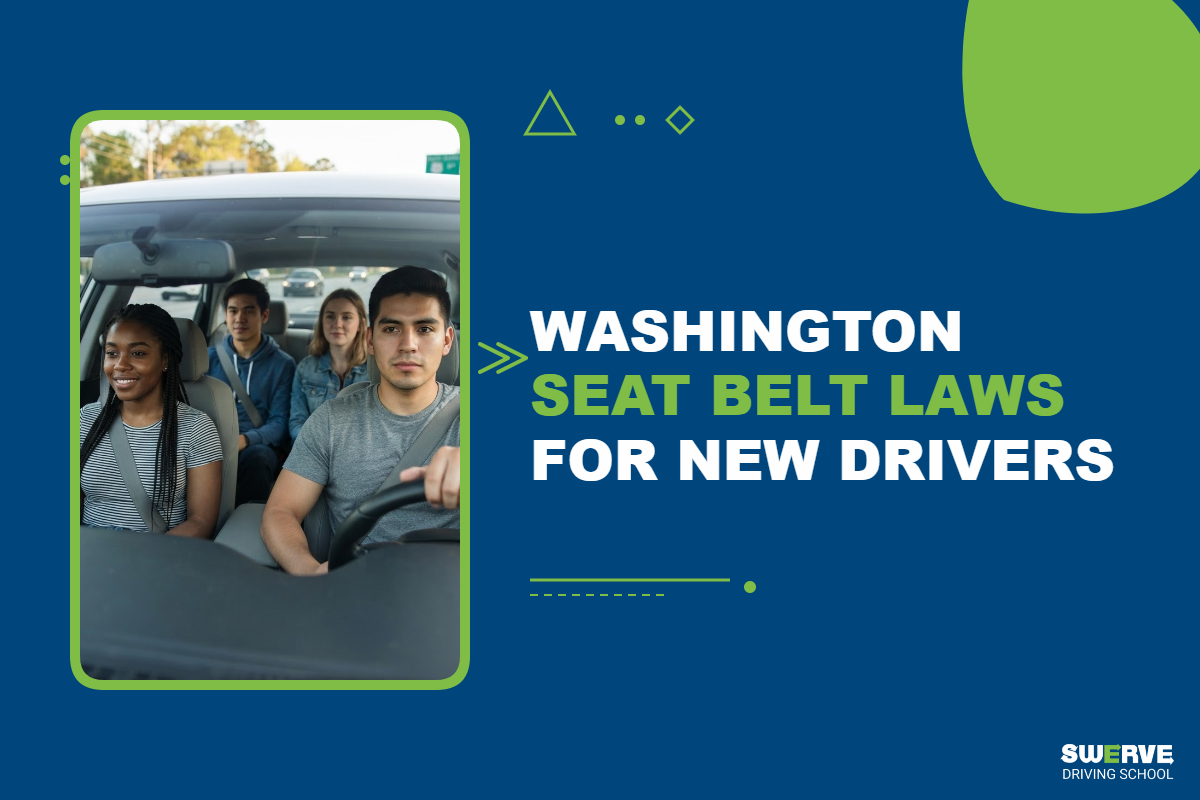
Washington state seat belt guide for teens
Seat belts are one of the first safety rules new drivers learn, but they are also one of the easiest rules to treat casually once a teen starts driving with friends. In Washington, that is a mistake. Seat belt use is not optional for the driver, the front-seat passenger, the back-seat passenger, or younger passengers who still need a child restraint or booster seat.
This Washington state seat belt guide for teens explains the rules in plain language. It covers what Washington law requires, how a seat belt should fit, what teen drivers should do before shifting out of park, and how seat belt habits connect to intermediate license restrictions, younger siblings, friends in the back seat, and driving practice.
The goal is simple: every person, every seat, every trip. A teen driver should make buckling up part of the same routine as checking mirrors, starting the engine, and looking before moving.
Why seat belt rules matter for teen drivers
Teen drivers are still building judgment, scanning habits, speed control, and confidence. That makes basic safety habits especially important. A seat belt cannot prevent every crash, but it can make the difference between walking away and suffering a serious or fatal injury.
The Washington Traffic Safety Commission Buckled Up page describes seat belt use as a major part of the state’s traffic safety culture. WTSC’s Washington Click It or Ticket reminder also explains that Washington has a primary seat belt law and that unrestrained occupants remain a serious factor in traffic deaths.
For a new driver, the seat belt rule should not depend on distance, weather, time of day, road type, or who is riding along. Most crashes happen during ordinary trips, not during dramatic driving situations. A quick drive to school, a short trip to practice, or a ride across town still deserves the same safety routine.
A strong seat belt habit also helps teens become better leaders in the car. Friends may talk, play music, check phones, or rush the driver. A teen who calmly says “I’m not moving until everyone is buckled” is setting a standard before the trip starts.
The basic Washington seat belt rule
The clearest place to start is the Washington seat belt law. Under that law, every person age 16 or older who is operating or riding in a motor vehicle must wear a safety belt that is properly adjusted and securely fastened. The same law also says a driver may not operate a motor vehicle unless every child passenger under age 16 is either wearing a safety belt or is securely fastened in an approved child restraint device.
The Washington State Driver Guide explains the same rule in driver-training language: every person in a moving vehicle must wear a seat belt or be securely fastened into an approved child restraint device.
For teen drivers, that means the rule is broader than “the driver needs a seat belt.” A safer way to remember it is:
- The teen driver must be buckled before driving.
- Every passenger needs a working seat belt or the correct child restraint.
- Passengers age 16 or older are required to wear a properly adjusted and fastened seat belt.
- A driver is responsible for making sure child passengers under age 16 are properly restrained.
- No one should share a seat belt, sit on another passenger’s lap, or ride in a seating position without a usable restraint.
- The vehicle should not move until everyone is buckled correctly.
A teen driver should treat this as a non-negotiable checklist item. If a passenger refuses, the correct response is not to argue while driving. The correct response is to stay parked or pull over safely and wait until the passenger buckles up.
What “properly adjusted and securely fastened” means
Washington law uses the phrase properly adjusted and securely fastened, which is important because wearing a belt incorrectly can reduce its protection. The Washington State Driver Guide gives practical guidance on proper seat belt position.
A properly worn seat belt should fit like this:
- The shoulder belt should lie snugly across the shoulder and chest.
- The shoulder belt should not cross the neck or face.
- The shoulder belt should never be placed behind the back or under the arm.
- The lap belt should sit low and snug across the hips or upper thighs.
- The lap belt should not ride up across the stomach.
- The belt should not be twisted.
- The passenger should sit upright, not slouched or reclined far back.
- The head restraint should be adjusted so it helps protect the head and neck.
For teen drivers, proper fit also starts with seat position. Adjust the seat before driving so you can press the pedals fully, steer comfortably, see clearly, and keep a safe distance from the steering wheel. Then buckle the belt so it lies flat against your body.
A common mistake is placing the shoulder belt behind the back because it feels uncomfortable. That defeats the purpose of the belt. If the belt rubs the neck, adjust the seat, check the height adjuster if the vehicle has one, and sit fully back in the seat. Do not solve the problem by wearing the belt incorrectly.
Seat belt rules for teen passengers
Teen passengers sometimes assume the driver is the only person who needs to worry about traffic laws. That is not how Washington seat belt rules work. A passenger who is 16 or older must wear a properly adjusted and fastened seat belt when riding in a motor vehicle.
This matters for teens riding with parents, friends, older siblings, ride-share drivers, teammates, or classmates. The back seat is not an exception. The middle seat is not an exception. A short ride is not an exception.
As a teen passenger, the safest habit is to buckle up before the driver asks. As a teen driver, the safest habit is to check before moving. A simple “everyone buckled?” takes two seconds and removes doubt.
Seat belt rules for younger siblings and child passengers
Some teen drivers regularly transport younger brothers, sisters, cousins, or children they babysit. In that situation, the driver needs to understand more than the adult seat belt rule.
The Washington child passenger restraint law sets age, height, and seating requirements for children under 16. The King County car seat and seat belt guidance also summarizes Washington’s child passenger restraint rules in a practical format for families.
In general, Washington requires:
- Children under age 2 to ride in a rear-facing child restraint until they reach the seat manufacturer’s height or weight limit.
- Children ages 2 to 4 to ride in a child restraint with a harness, rear-facing or forward-facing as appropriate for the child and seat.
- Children age 4 and older to ride in a car seat or booster seat until the vehicle seat belt fits properly, typically when the child reaches 4 feet 9 inches tall.
- Children under age 13 to ride in the back seat when practical.
- Child restraint systems and booster seats to meet federal standards and be used according to the vehicle and seat manufacturer’s instructions.
A teen driver should not guess whether a younger child has outgrown a booster seat. If the passenger is under 16 and does not fit the vehicle seat belt correctly, the safe answer is to use the correct restraint. Parents and guardians should provide clear instructions before a teen drives younger children.
This is especially important for shorter preteens and younger teens. Turning 12, 13, or 14 does not automatically mean a passenger fits an adult seat belt correctly. Fit depends on height, body position, and whether the lap and shoulder belt sit on the strong parts of the body.
A simple seat belt fit check for teens
A teen does not need to be a car seat technician to notice an obviously poor seat belt fit. Before driving, use this quick check for yourself and your passengers:
- The passenger is sitting upright with their back against the seat.
- The lap belt rests low across the hips or upper thighs, not across the stomach.
- The shoulder belt crosses the middle of the chest and shoulder.
- The belt is not behind the back, under the arm, twisted, or loose.
- The passenger can stay in that position for the whole trip.
If a younger passenger cannot pass this check, ask a parent or guardian whether a booster seat or other restraint is needed. When in doubt, do not drive until the restraint question is resolved.
Seat belts and Washington intermediate license rules
Seat belt rules apply to all drivers, but they are especially important for teens with an intermediate license. Washington teens ages 16 and 17 have license restrictions that are separate from seat belt rules. Those restrictions limit late-night driving and, for part of the intermediate-license period, limit certain passengers.
The Washington Department of Licensing license guide for ages 16 to 17 explains the licensing steps and restrictions for teen drivers. The current Washington intermediate license law includes passenger limits, a 1 a.m. to 5 a.m. driving restriction with limited exceptions, and wireless communication restrictions for intermediate license holders.
For a seat belt guide, the most important point is this: passenger restrictions and seat belt requirements work together. A passenger may be allowed under the intermediate-license rules and still must be buckled correctly. A passenger may be wearing a seat belt and still not be allowed under the intermediate-license rules.
Teen drivers should check both questions before the vehicle moves:
- Am I legally allowed to drive with these passengers under my license restrictions?
- Is every person in the vehicle properly buckled or properly restrained?
Both answers need to be yes.
Seat belts during learner permit practice
A teen with a learner permit should build seat belt habits before becoming licensed. The Washington learner permit rules explain that a permitted driver must have the permit with them, drive with a qualifying licensed driver in the front passenger seat, and avoid phone or mobile-device use while driving except for emergency use.
That supervising adult should also model seat belt use. A practice drive should not begin until the teen, the supervising driver, and any passengers are buckled. This is a good time for parents and guardians to make the routine automatic:
- Adjust the seat.
- Adjust the mirrors.
- Set the climate controls and navigation before moving.
- Buckle the seat belt correctly.
- Confirm that passengers are buckled.
- Check around the vehicle.
- Shift into gear only when it is safe.
A teen who practices this routine during supervised driving will be more likely to repeat it during the drive test and during independent driving.
Why back-seat seat belts are not optional
Many teens buckle up automatically in the front seat but become less careful in the back seat. That is dangerous and illegal. Washington’s seat belt requirement applies to people riding in a motor vehicle, not only to the driver and front passenger.
The back seat may feel safer because it is farther from the windshield, but an unbuckled back-seat passenger can still be seriously injured, ejected, or thrown into other occupants during a crash. A back-seat passenger can also distract the driver by moving around, leaning forward, or roughhousing.
The Washington Click It or Ticket reminder notes that Washington’s primary seat belt law allows a traffic stop for seat belt violations and that officers look for unbuckled drivers and passengers during enforcement campaigns. For teens, the takeaway is simple: the back seat is still a seat belt seat.
Airbags do not replace seat belts
A common myth is that airbags provide enough protection on their own. They do not. The Washington State Driver Guide explains that airbags and seat belts work together.
Airbags are designed around a belted occupant sitting in the proper position. If a person is unbuckled, slouched, leaning forward, or wearing the belt incorrectly, an airbag can provide less protection and may even add injury risk in certain crashes.
Teens should remember these airbag basics:
- Wear the seat belt even in a vehicle with airbags.
- Sit upright and keep the shoulder belt across the chest.
- Do not lean against the door or dashboard.
- Keep feet off the dashboard.
- Make sure younger passengers ride in the back seat when required or recommended.
- Never hold a child or pet in the front seat instead of using the proper restraint.
Common seat belt mistakes new drivers should avoid
Most seat belt problems come from small shortcuts. Teen drivers should learn to spot and correct these mistakes before they become habits.
Starting the car before checking passengers
Do not wait until you are merging, turning, or leaving a parking lot to realize someone is not buckled. Make the check while the vehicle is still parked.
Letting passengers share one belt
One seat belt is designed for one person. Sharing a belt does not provide proper protection and should never be allowed.
Putting the shoulder belt behind the back
This leaves the upper body unrestrained and can increase injury risk. If the belt is uncomfortable, adjust the seat or belt height if the vehicle allows it.
Using only the lap belt when a shoulder belt is available
A lap-and-shoulder belt provides better restraint for the upper body. Use the complete belt system provided for the seating position.
Slouching or reclining too far
A seat belt works best when the occupant is sitting upright. Reclining far back can allow the body to slide under the belt in a crash.
Ignoring broken or stuck seat belts
If a belt does not latch, retract, or fit correctly, do not use that seating position until the belt is repaired. A teen should not carry more passengers than the vehicle has working seat belts.
Thinking short trips do not count
Seat belts are for every trip, including short drives. A driver does not get advance notice before a crash.
What to do when a passenger refuses to buckle up
Teen drivers may worry about sounding strict, especially when friends are in the car. It helps to have a simple script ready before the situation happens.
Use one of these lines:
- “I’m not moving until everyone is buckled.”
- “It’s Washington law, and I’m responsible for this car.”
- “Buckle up or we are staying parked.”
- “I’m not risking a ticket, my license, or anyone getting hurt.”
Do not argue while driving. If you notice an unbuckled passenger after you are already moving, find a safe place to pull over. Keep your attention on driving until the vehicle is stopped.
Parents can make this easier by telling teens in advance that they are allowed to refuse to drive an unbuckled passenger. That gives the teen a clear family rule to rely on, not just personal preference.
Seat belts in trucks, SUVs, ride-shares, and older vehicles
The same basic rule applies across ordinary passenger vehicles: use the seat belt provided for the seating position. Teen drivers should not assume that the rule changes because the vehicle is a truck, SUV, van, ride-share, or older family car.
Good rules for any vehicle include:
- Do not carry more passengers than there are working seat belts.
- Do not use a seating position with a broken or missing belt.
- Do not ride in a cargo area that is not designed as a passenger seat.
- Do not let passengers sit sideways, kneel, or lie down while the vehicle is moving.
- Use the vehicle’s lap-and-shoulder belt when one is available.
- Ask an adult to repair or inspect a faulty belt before using that seat.
In a ride-share or someone else’s car, teens should still buckle up immediately. Being a passenger does not remove the safety risk or the legal requirement.
How parents and guardians can reinforce seat belt habits
Parents and guardians have a major influence on whether teens take seat belts seriously. The Washington safe driving resources for teens include resources for safe teen driving, including tools that parents can use to support better driving habits.
WTSC also supports seat belt education for young drivers through the Washington Traffic Safety Commission school seat belt programs. The message is not just that teens should know the law. The message is that teens should build a normal routine that makes buckling up automatic.
Parents and guardians can help by:
- Wearing their own seat belt every time.
- Refusing to move the vehicle until everyone is buckled.
- Making seat belt use part of the family driving agreement.
- Practicing passenger checks during supervised driving.
- Teaching teens how to respond when friends refuse to buckle.
- Checking that younger children are in the correct car seat or booster seat.
- Talking about real consequences without turning every drive into a lecture.
The best instruction is consistent modeling. A parent who buckles up on every trip teaches more than a parent who only talks about the rule before the drive test.
How seat belt knowledge helps with the Washington knowledge and drive tests
New drivers should study occupant protection as part of normal test preparation. The Washington driver training and testing page points applicants to the driver guide and testing information. The driver guide includes seat belt position, child seats, airbags, and driver preparation topics that can appear in driver education and knowledge-test preparation.
Seat belt habits also matter on the drive test. Even if the examiner does not ask a long question about occupant protection, a driver should start the test by adjusting the seat and mirrors, fastening the seat belt, and making sure the vehicle is ready to move safely.
Before any practice drive or test drive, a teen should be able to answer these questions:
- Who in the vehicle must wear a seat belt?
- Who is responsible for passengers under age 16?
- Where should the shoulder belt lie?
- Where should the lap belt lie?
- When does a child need a booster seat?
- Where should children under age 13 ride when practical?
- Why do airbags not replace seat belts?
A pre-drive seat belt checklist for teen drivers
Use this checklist before every drive. It should take less than a minute.
- My seat is adjusted so I can reach the pedals and see clearly.
- My head restraint is adjusted correctly.
- My seat belt is flat, snug, and properly positioned.
- The shoulder belt is across my shoulder and chest.
- The lap belt is low across my hips or upper thighs.
- Every passenger has a working seat belt or correct child restraint.
- No passenger is sharing a belt or sitting on someone’s lap.
- Younger passengers are in the correct seat or booster.
- Children under 13 are in the back seat when practical.
- Passengers are buckled before I shift into gear.
- I am following my permit or intermediate-license passenger restrictions.
- I am ready to focus on driving, not arguing about safety.
Frequently asked questions about Washington seat belt rules for teens
Do teens have to wear seat belts in the back seat in Washington?
Yes. Washington seat belt rules apply to passengers, not just the driver or front-seat passenger. A teen riding in the back seat should buckle up before the vehicle moves.
Can a teen driver be stopped for a seat belt violation?
Yes. WTSC’s Washington Click It or Ticket reminder states that Washington has a primary seat belt law, which allows a traffic stop for seat belt violations.
Who is responsible when a passenger under 16 is not buckled?
The Washington seat belt law says a person may not operate a motor vehicle unless child passengers under age 16 are wearing a safety belt or are securely fastened into an approved child restraint device. Teen drivers should treat every under-16 passenger as their responsibility before the vehicle moves.
What if a 16- or 17-year-old passenger refuses to wear a seat belt?
A passenger age 16 or older is legally required to wear a properly adjusted and fastened seat belt. Even when the passenger is old enough to be responsible for their own belt, a teen driver should not drive until everyone is buckled.
Does a short teen under age 16 still need a booster seat?
Possibly, yes. Washington child restraint rules apply to children under age 16, and children who are not tall enough for the adult seat belt to fit properly may need a booster seat. The Washington child passenger restraint law and King County car seat and seat belt guidance explain the height and fit requirements.
Is it okay to put the shoulder belt under the arm?
No. The Washington State Driver Guide says the shoulder belt should lie snugly across the shoulder and chest. Wearing it under the arm or behind the back is not proper seat belt use.
Do seat belt rules apply while driving with a learner permit?
Yes. Permit practice is still driving on public roads. The teen, supervising driver, and passengers should be properly buckled before the vehicle moves.
Can a teen driver carry more passengers than there are seat belts?
No teen driver should do that. Every passenger needs a safe seating position with a working restraint, and intermediate-license passenger restrictions may also limit who can ride in the vehicle.
Do airbags make seat belts less important?
No. Airbags are designed to work with seat belts. A person who is unbuckled or wearing the belt incorrectly can receive much less protection in a crash.
Final seat belt checklist for Washington teen drivers
Before every trip, remember these rules:
- Buckle your own seat belt before driving.
- Require every passenger to buckle up before the vehicle moves.
- Use one seat belt per person.
- Make sure the belt lies flat and snug across the shoulder, chest, hips, and upper thighs.
- Never place the shoulder belt under the arm or behind the back.
- Make sure passengers under 16 are properly restrained.
- Use the correct car seat or booster for younger passengers.
- Keep children under 13 in the back seat when practical.
- Follow learner permit or intermediate-license passenger restrictions.
- Do not drive with a broken or missing seat belt in use.
- Pull over safely if someone unbuckles during the trip.
- Make “everyone buckled” a normal part of every drive.
Washington seat belt rules are not complicated, but they require consistency. A teen driver does not need to give a long speech, memorize every legal phrase, or argue with passengers. The safest routine is simple: adjust the seat, buckle up, check passengers, and refuse to move until everyone is properly restrained.
That habit protects the teen driver, protects passengers, supports Washington’s licensing rules, and creates a calmer car before the first turn, lane change, or stop sign. For new drivers, that is exactly the kind of routine that builds confidence and keeps people safer on the road.