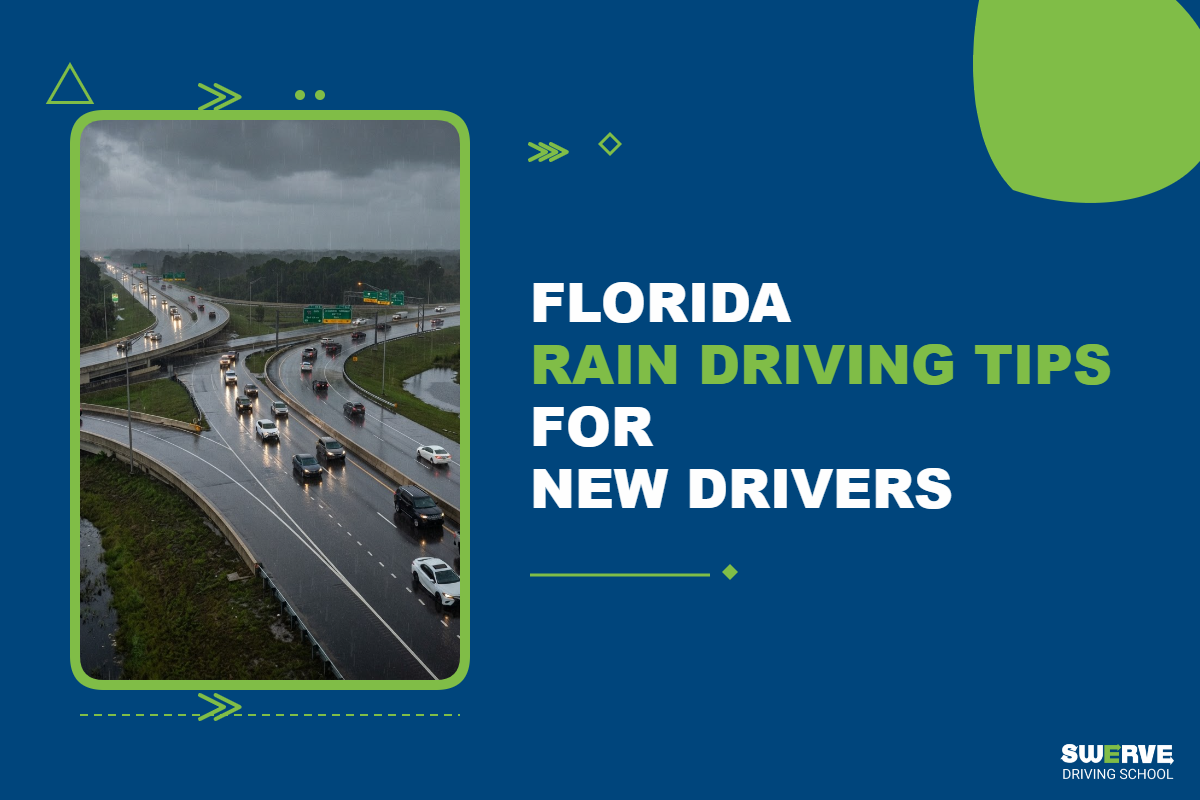
Florida rain driving tips for new drivers
Rain is part of driving in Florida. A short trip can begin in clear weather and turn into a heavy afternoon storm within minutes. For a new driver, that sudden change can make the road feel completely different. Lane lines become harder to see, vehicles throw spray across the windshield, stopping distance increases and standing water can appear before you have time to react.
Learning how to drive in rain is not just about slowing down. It is about knowing the law, preparing the vehicle, choosing safe speeds, giving other drivers extra space and recognizing when conditions are too dangerous to continue. Florida drivers also need to know what to do around flooded streets, low visibility, slick highways and fast-changing weather.
This guide explains the rain driving habits every new Florida driver should practice before getting caught in a storm.
Start with Florida’s official safe-driving guidance
New drivers should begin with official state resources instead of relying only on advice from friends, social media or practice-test websites. The Florida Class E Driver License Handbook is the main driver manual for Florida license applicants, and it includes questions and information related to wet roads, rain, visibility and safe vehicle operation.
The Florida Highway Safety and Motor Vehicles agency also publishes Florida severe weather driving guidance for motorists who may encounter rain, flooding, storms and other weather hazards. For visibility problems caused by heavy rain, fog or smoke, review FLHSMV’s low-visibility driving safety guidance.
Before driving in bad weather, new drivers should also know how to check conditions through Florida’s official 511 traveler information system. FL511 provides real-time traffic information, incidents, crashes, closures, congestion and severe-weather alerts for many major Florida roadways.
Why rain driving in Florida is different
Florida rain can be intense, local and sudden. One side of town may be dry while another has standing water, reduced visibility and slow-moving traffic. This can surprise new drivers because the weather may not look serious when they first leave home.
Rain creates several risks at the same time:
- Tires have less grip on wet pavement.
- Brakes may need more distance to stop the vehicle.
- Oil and debris can rise to the surface when rain begins.
- Windshield visibility can drop quickly.
- Drivers may make sudden lane changes to avoid puddles.
- Pedestrians and cyclists may be harder to see.
- Road shoulders and low spots can flood.
- Highway spray can temporarily block your view.
A safe new driver treats rain as a change in the driving environment. The posted speed limit is not always the safe speed. A lane that looked clear a few seconds ago may contain standing water. A familiar intersection may require a longer stop. A quick glance at the windshield is not enough; you have to constantly update your speed, space and route choices.
Know the Florida rain driving laws first
Rain driving tips are easier to follow when you understand the legal basics. Florida law addresses headlights, speed, following distance and flashing lights during low-visibility conditions.
Turn on your headlights during rain
Florida law requires vehicles to display lighted lamps during rain, smoke or fog. The official Florida headlights in rain law also requires lights from sunset to sunrise, including twilight hours.
For new drivers, the practical rule is simple: when the wipers are on, turn the headlights on.
Do not rely only on daytime running lights. Daytime running lights may illuminate the front of the vehicle but may not activate the taillights. In rain, other drivers need to see both the front and rear of your vehicle. Turn on the full headlights so your taillights come on too.
Reduce speed when conditions require it
Florida’s reasonable and prudent speed law requires drivers to control speed based on conditions and potential hazards. The law also specifically addresses reducing speed when weather or highway conditions create a special hazard.
This matters because a driver can be unsafe even while driving at or below the posted speed limit. If heavy rain, standing water, poor visibility or traffic congestion makes the posted limit too fast, you need to slow down.
New drivers should think of the speed limit as the maximum under good conditions, not a promise that the speed is safe during a storm.
Increase your following distance
Florida’s following too closely law says a driver may not follow another vehicle more closely than is reasonable and prudent, considering speed, traffic and highway conditions.
Rain changes what is reasonable. Wet pavement increases stopping distance, and heavy spray can reduce how quickly you notice brake lights ahead. Leave more room than you would on a dry road. If another driver moves into that space, rebuild your cushion instead of tailgating.
Use hazard lights only when they fit the situation
Florida law has specific rules for flashing lights. The Florida flashing lights and hazard light statute allows flashing lights when a vehicle is lawfully stopped or disabled on the highway and during periods of extremely low visibility on roads with a posted speed limit of 55 mph or higher.
That does not mean new drivers should use hazard lights during every ordinary rain shower. In normal rain, use headlights, slow down and increase following distance. If visibility becomes extremely poor on a high-speed road, follow the law carefully and focus on getting to a safer location. If you pull off the road and stop, then hazard lights can help other drivers see that your vehicle is stopped.
Prepare the vehicle before rainy season
Safe rain driving starts before the storm. A new driver should not discover worn wipers, weak tires or burned-out lights during a downpour.
Check tire tread and pressure
Tires are your only contact with the road. Worn tires have less ability to push water away from the tread and maintain traction. The National Highway Traffic Safety Administration’s TireWise tire safety guidance explains that tires should be replaced when tread is worn down to 2/32 of an inch and recommends checking tread regularly.
For Florida rain, do not wait until tires look completely bald. Ask a parent, instructor, mechanic or tire shop to show you how to check tread depth and tire pressure. Check the pressure when tires are cold and use the pressure listed on the vehicle’s door placard or in the owner’s manual, not the number printed on the tire sidewall.
Replace worn windshield wipers
Windshield wipers wear out from sun, heat, sand and everyday use. In Florida, heat can harden the rubber and make the blades streak, skip or chatter. If the wipers leave blurry bands across the glass, replace them before the next storm.
New drivers should also know how to use every wiper speed. Light rain, heavy rain and road spray may require different settings. Practice operating the wipers while parked so you are not searching for the controls in traffic.
Make sure all lights work
Rain driving depends on being seen. Check:
- Low-beam headlights
- High-beam headlights
- Taillights
- Brake lights
- Turn signals
- Hazard lights
- License plate light
Clean the lenses if they are cloudy or covered with road grime. A working light is less helpful if dirt or oxidation blocks it.
Keep the windshield clean inside and outside
A dirty windshield can make rain glare worse, especially at night. Clean the outside glass, but do not forget the inside. Film from dust, air fresheners, vaping, food and normal interior use can scatter light and make oncoming headlights look brighter.
Keep washer fluid filled. Plain water is not always enough to remove road spray, bugs or oily residue.
Learn the defroster before you need it
Rain can fog the inside of the windshield when humidity rises and cabin temperature changes. New drivers should know how to turn on the front defroster, rear defroster and air conditioning. In many vehicles, using air conditioning with the defroster helps remove moisture from the cabin air.
Practice this while parked. During a storm, you should not be looking down for climate controls while the vehicle drifts in the lane.
Check conditions before you leave
Many rainy driving problems can be avoided by leaving later, taking a safer route or choosing not to drive during the worst part of a storm.
Use Florida 511 emergency road information before and during severe weather to check for roadway conditions, closures, flooding, evacuation routes and travel alerts. You can also use the Florida 511 mobile app to check current traffic and incident information, but do not handle the phone while driving. Have a passenger check it or stop somewhere safe first.
Before leaving, ask:
- Is heavy rain already occurring along the route?
- Are there crash reports or road closures?
- Does the route include low-lying roads that often flood?
- Will the drive involve high-speed roads during poor visibility?
- Is there a safer time to leave?
- Is there a parent, instructor or experienced driver available to ride along?
For a new driver, delaying a nonessential trip is often the safest decision.
What to do when rain starts
The first few minutes of rain can be more slippery than they look. Oil, dust and debris on the pavement can mix with water and reduce traction. Do not wait until rain becomes heavy to adjust your driving.
When rain begins:
- Turn on the headlights.
- Turn on the wipers.
- Reduce speed gradually.
- Increase following distance.
- Avoid sudden steering, braking or acceleration.
- Watch for vehicles making abrupt lane changes.
- Look farther ahead for brake lights and standing water.
- Keep both hands on the wheel.
Do not slam on the brakes just because rain begins. Check your mirrors, ease off the accelerator and create more space.
Drive smoothly on wet roads
Smooth driving is one of the most important rain driving skills. Wet pavement gives your tires less grip, so every abrupt input matters more.
Use gentle control when you:
- Accelerate from a stop
- Brake for a light
- Turn at an intersection
- Change lanes
- Merge onto a highway
- Exit a ramp
- Drive through a curve
New drivers sometimes make the mistake of steering quickly when they become nervous. In rain, quick steering can cause the tires to lose grip. Look where you want the vehicle to go and use steady, gradual movements.
Leave more room than normal
Following distance is one of the easiest rain-driving habits to improve. On dry roads, many drivers already follow too closely. In rain, that mistake becomes more dangerous.
Leave extra space because:
- Wet brakes and tires can increase stopping distance.
- Spray can hide brake lights ahead.
- A vehicle in front may stop suddenly for standing water.
- Drivers may slow abruptly when visibility drops.
- Motorcycles and bicycles may need extra room to avoid slick areas.
Do not treat open space as something you must close. In bad weather, space is protection.
Use low beams in heavy rain
Low-beam headlights help other drivers see you and help you see the road without creating excessive glare. FLHSMV’s low-visibility driving safety guidance advises drivers to use low beams or fog lights when visibility is poor.
Avoid using high beams in heavy rain, fog or smoke. High beams can reflect back toward you and make visibility worse. If you cannot see far enough to drive safely with low beams, reduce speed and look for a safe place to stop away from travel lanes.
Avoid cruise control in rain
Cruise control is not a good choice on wet roads. You need immediate control over acceleration and speed, especially when water begins to collect in the lane.
If the vehicle starts to hydroplane while cruise control is set, the system may try to maintain speed at the exact moment you need to ease off. Turn cruise control off before or during rain and control speed manually.
Understand hydroplaning
Hydroplaning happens when the tires ride on a layer of water instead of maintaining full contact with the road. It can occur during heavy rain, in standing water or when tires are worn or underinflated.
Warning signs may include:
- Steering suddenly feels light.
- The vehicle drifts without responding normally.
- The engine sound changes as tires lose contact.
- The rear of the vehicle feels unstable.
- You feel a floating sensation.
Hydroplaning is more likely at higher speeds, but it can happen at lower speeds when water is deep enough.
What to do if your vehicle hydroplanes
If you think the vehicle is hydroplaning:
- Stay calm.
- Ease off the accelerator.
- Keep the steering wheel pointed where you want to go.
- Do not slam on the brakes.
- Avoid sudden steering corrections.
- Wait for the tires to regain traction.
- Slow down and create more space.
If the vehicle begins to skid, continue looking where you want the car to go. Do not stare at the guardrail, ditch or vehicle you are trying to avoid.
Watch for standing water
Standing water can hide potholes, debris, uneven pavement and lane markings. It can also pull the vehicle to one side if only one set of tires enters the water.
Look far ahead for:
- Water collecting near curbs
- Water running across lanes
- Shiny patches under bridges
- Puddles at intersections
- Flooded right lanes
- Road spray from vehicles ahead
- Vehicles braking unexpectedly
When safe, change lanes early to avoid deep water. Do not make a sudden lane change at the last second. If you cannot avoid a shallow patch, reduce speed before reaching it and keep the wheel steady while passing through.
Never drive through flooded roads
Flooded roads are one of the most dangerous Florida rain hazards. You cannot reliably judge water depth from the driver’s seat, especially at night or during heavy rain. The road may also be washed out beneath the water.
The National Weather Service’s Turn Around, Don’t Drown flood safety guidance warns drivers not to drive into flooded areas. It takes surprisingly little moving water to create a serious danger for a vehicle.
New drivers should follow this rule every time: if water covers the road and you cannot clearly confirm it is shallow and safe, turn around.
Never drive around barricades. They are placed because the road is closed or unsafe. Going around them can put you, passengers and rescuers in danger.
What to do if water rises around your vehicle
If water starts rising around your vehicle, the right response depends on the situation. Do not assume you can simply accelerate through.
If the road ahead is flooded:
- Stop before entering the water.
- Turn around if it is safe.
- Choose another route.
- Call for help if you are trapped.
If the vehicle stalls in water:
- Do not keep trying to restart it.
- Turn on hazard lights if safe and appropriate.
- Call for help.
- Follow emergency instructions.
- Move to higher ground only if it is safe to leave the vehicle.
Moving water is especially dangerous. If you are unsure, stay put and contact emergency services.
Be extra careful at intersections
Rain makes intersections more complicated. Drivers may slide through a stop, misjudge a yellow light or accelerate too quickly when the light turns green. Pedestrians may rush across the street to get out of the rain, and bicyclists may need more room to avoid puddles or slick paint.
At rainy intersections:
- Begin braking earlier.
- Stop fully before the line or crosswalk.
- Check mirrors before slowing.
- Watch for rear-end risk from drivers behind you.
- Scan for pedestrians under umbrellas or hoods.
- Look for bikes and scooters near the curb.
- Wait a moment before entering on a green light if cross traffic appears unable to stop.
Do not speed up to beat a yellow light in rain. Wet roads and rushed decisions are a bad combination.
Make turns slowly and correctly
Turning too fast on wet pavement can cause the vehicle to slide outward. Slow before the turn, not in the middle of it. Brake while traveling straight, then ease through the turn with steady steering.
For rainy turns:
- Signal early.
- Brake smoothly before the turn.
- Check for pedestrians and cyclists.
- Enter the proper lane.
- Avoid cutting across painted lines.
- Accelerate gently after the vehicle is straight.
Painted crosswalks, lane arrows and stop bars can be slick when wet. Motorcycle riders and bicyclists know this, but new drivers should notice it too.
Be careful around large trucks and buses
Large vehicles throw heavy spray, especially on highways. Passing or being passed by a truck can temporarily cover your windshield with water.
When driving near trucks or buses in rain:
- Increase following distance.
- Avoid lingering beside the vehicle.
- Keep the wipers ready for spray.
- Pass only when necessary and safe.
- Make sure you can see clearly before changing lanes.
- Do not cut in closely after passing.
A truck driver may not see a small car hiding in the spray. Make your movements predictable and avoid sudden lane changes.
Handle Florida highway rain with extra caution
Rain on Florida highways can change quickly from manageable to dangerous. High speeds, traffic volume, standing water, poor visibility and road spray all add risk.
Use these habits on highways:
- Turn on low-beam headlights.
- Keep cruise control off.
- Increase following distance.
- Stay out of clusters of aggressive drivers.
- Avoid unnecessary lane changes.
- Watch for brake lights far ahead.
- Reduce speed before reaching standing water.
- Leave extra room near ramps.
- Be patient when traffic slows.
When merging in rain, accelerate smoothly and choose a larger gap than you would need in dry weather. Drivers already on the highway may have limited visibility and longer stopping distance.
When exiting, signal early and reduce speed in the deceleration lane. Curved ramps can be slick, especially when water collects near the outside edge.
Know how to pull over safely
Sometimes the safest choice is to stop driving until visibility improves. The problem is that stopping in the wrong place can create another hazard.
If rain becomes too heavy to see:
- Signal early.
- Move out of the travel lane when safe.
- Look for a parking lot, rest area or wide safe shoulder.
- Stop as far from moving traffic as possible.
- Keep your seat belt on.
- Use hazard lights when stopped so other drivers can see you.
- Wait until visibility improves before reentering traffic.
Avoid stopping under bridges, in travel lanes or in low areas where water may collect. Do not stop just over a hill or around a curve where approaching drivers may not see you.
Drive defensively around other drivers
Rain affects everyone differently. Some drivers slow too much, some do not slow enough and some panic when visibility drops. A new driver should expect unpredictable behavior.
Watch for drivers who:
- Brake suddenly
- Drive without headlights
- Use worn wipers
- Drift between lanes
- Tailgate
- Speed through puddles
- Change lanes to avoid water
- Stop on the shoulder without warning
- Drive with fogged windows
Do not try to teach another driver a lesson. Create space, let aggressive drivers pass and focus on your own safe choices.
Night rain driving is harder
Rain at night creates glare from headlights, streetlights, traffic signals and wet pavement. Lane lines may become harder to see, and pedestrians can blend into the background.
For night rain driving:
- Clean the windshield inside and outside.
- Use low beams unless conditions clearly allow high beams.
- Reduce speed more than you would during daylight rain.
- Watch for reflections that hide lane markings.
- Leave extra room near intersections.
- Be careful around pedestrians wearing dark clothing.
- Avoid staring directly at oncoming headlights.
New drivers should not make their first rain-driving experience a nighttime highway drive. Practice daylight rain with an experienced adult before adding the challenge of darkness.
Practice rain driving with supervision
New drivers need practice in safe, controlled steps. Do not wait until you are alone in a severe storm to learn how the vehicle feels on wet pavement.
A good practice progression is:
- Review the rules before driving.
- Practice using lights, wipers and defrosters while parked.
- Drive in light rain on quiet neighborhood streets with a supervising adult.
- Practice smooth braking and turns in a safe, legal area.
- Drive on larger roads in moderate rain with supervision.
- Practice highway merging only when visibility is reasonable.
- Avoid severe storms until your skills are stronger.
For teens, a parent or instructor should explain what they are watching for during the drive. Afterward, review specific habits, such as following distance, lane position, speed choice and mirror use.
Prepare a small rainy-day vehicle kit
A simple kit can make rain delays and unexpected problems easier to handle.
Consider keeping these items in the vehicle:
- Small flashlight
- Phone charger
- Rain jacket or poncho
- Paper towels or microfiber cloth
- Basic first-aid kit
- Bottled water
- Tire pressure gauge
- Reflective warning triangles if available
- Jumper cables or jump starter
- Emergency contact information
Do not store loose items where they can roll under the pedals. Keep the kit secure.
Mistakes new drivers make in Florida rain
Many rainy-weather crashes begin with small errors. New drivers should watch for these common mistakes.
Waiting too long to turn on headlights
Headlights are not only for seeing the road. They help other drivers see you. Turn them on as soon as rain begins.
Driving too fast for visibility
If you cannot see far enough ahead to stop safely, you are driving too fast for conditions. Slow down before visibility becomes a crisis.
Following too closely
Tailgating leaves no margin for slick pavement, sudden braking or spray. Increase your space and keep rebuilding it.
Braking hard in standing water
Hard braking can reduce control. Slow before reaching water when possible, keep the wheel steady and avoid abrupt movements.
Using high beams in heavy rain
High beams can reflect off rain and make it harder to see. Use low beams in poor visibility.
Making sudden lane changes
A last-second lane change to avoid a puddle can create a bigger danger. Scan farther ahead and move early if needed.
Driving through flooded streets
Flooded roads can be deeper than they look. The safest choice is to turn around.
Depending too much on driver-assistance features
Lane-keeping systems, adaptive cruise control and automatic emergency braking may not perform the same way in heavy rain, spray or standing water. Stay fully involved in the driving task.
What to do after a storm
Rain risks do not disappear when the sky clears. Roads may still be wet, flooded or covered with debris.
After a storm:
- Watch for standing water.
- Avoid downed power lines.
- Treat dark traffic signals as dangerous intersections.
- Watch for crews clearing roads.
- Expect lane closures and detours.
- Test brakes gently after passing through shallow water.
- Leave extra time for traffic backups.
- Continue using headlights if rain, smoke or fog remains.
If the vehicle drove through water, pay attention to unusual sounds, warning lights, brake feel or engine behavior. Ask an experienced adult or mechanic to inspect the vehicle if something seems wrong.
Florida rain driving checklist for new drivers
Before driving in rain, confirm that:
- The trip is necessary.
- The route is not affected by flooding or closures.
- Headlights, brake lights and turn signals work.
- Wipers clear the windshield properly.
- Washer fluid is filled.
- Tires have safe tread and pressure.
- Mirrors and windows are clean.
- The defroster works.
- Your phone is charged.
- You know where you can stop safely if visibility drops.
While driving in rain:
- Turn on headlights.
- Use low beams.
- Slow down gradually.
- Increase following distance.
- Avoid cruise control.
- Steer, brake and accelerate smoothly.
- Watch for standing water.
- Do not drive through flooded roads.
- Avoid unnecessary lane changes.
- Pull over safely if visibility becomes too poor.
Frequently asked questions about Florida rain driving
Do new drivers have to turn on headlights when it rains in Florida?
Yes. Florida law requires vehicles to display lighted lamps during rain, smoke or fog. New drivers should turn on full headlights when using windshield wipers so other drivers can see both the front and rear of the vehicle.
Is it illegal to drive too fast in rain if you are still below the speed limit?
A posted speed limit is not always safe during rain. Florida law requires drivers to use a speed that is reasonable and prudent for the conditions. Heavy rain, standing water, poor visibility and traffic may require a slower speed.
Can you use hazard lights while driving in Florida rain?
Florida law allows flashing lights during periods of extremely low visibility on roads with a posted speed limit of 55 mph or higher, and when a vehicle is lawfully stopped or disabled. In ordinary rain, new drivers should use headlights, reduce speed and leave more space instead of turning on hazard lights while moving.
What should you do if your car starts to hydroplane?
Ease off the accelerator, keep the steering wheel pointed where you want to go, avoid hard braking and wait for the tires to regain traction. Afterward, slow down and increase following distance.
Should new drivers use cruise control in rain?
No. Cruise control is not recommended on wet roads because the driver needs direct control over speed and acceleration. Turn it off before or during rain.
How much space should you leave in rain?
Leave more space than you would on dry pavement. There is no single distance that works for every road, speed and vehicle, but you should have enough time to stop smoothly if the vehicle ahead brakes suddenly.
What should you do if the road is flooded?
Turn around and choose another route. Do not drive around barricades and do not enter water when you cannot confirm the depth or condition of the road underneath.
Is it safe to pull over during heavy rain?
It can be safer to stop when visibility becomes too poor, but you need to pull over in the right place. Look for a parking lot, rest area or wide safe shoulder away from traffic. Do not stop in a travel lane, under a bridge or in a low area that may flood.
What is the biggest rain-driving mistake new Florida drivers make?
The biggest mistake is underestimating how quickly conditions can change. A road that felt safe a minute ago may become slick, crowded or flooded. New drivers should slow down early, increase space and avoid taking risks in poor visibility.
Florida rain driving is a skill that improves with preparation and practice. New drivers should learn the law, keep the vehicle ready, check conditions before leaving and build experience gradually with supervision.
The most important habits are simple: turn on your headlights, slow down for conditions, leave more space, avoid sudden movements and never drive through flooded roads. When visibility becomes too poor or water covers the road, the safest choice is not to push through. It is to stop safely, turn around or wait until conditions improve.
A good driver is not the person who keeps going no matter what. A good driver is the person who knows when to adjust, when to wait and when to choose a safer route.